Fall 2026 cohort
Unlocking Arabic
A practical foundation in Qur’anic Arabic built around three classical primers on syntax and morphology. Grammar is taught for one purpose: so a student can begin to open the Qur’an and classical texts and read them directly, not just about them.
- Young adults, 17–25
- 16 weeks
- $400
Applications open
The Course in Brief
How does the structure of Arabic carry the meanings of revelation?
Arabic grammar is studied because every change in a word, an ending, a pattern, or a sentence can carry meaning. Learning how the language works allows a student to begin seeing dimensions of the Qur’an, hadith, supplications, and classical texts that a translation alone cannot preserve.
This course is a structured introduction to Arabic morphology (sarf, how words are formed) and syntax (nahw, how words relate inside a sentence). Students move through accessible English and Arabic introductory materials before concluding with a guided reading of al-Ajurrumiyyah, one of the most influential primers in the Arabic grammatical tradition.
From the first weeks, every concept is applied to selected Qur’anic phrases and short sacred texts. The aim is not conversational fluency, and not the whole of grammar in one semester. It is the vocabulary, concepts, habits, and analytical tools a student needs to begin reading Arabic deliberately and to continue into more advanced study.
Before you beginStudents should already be able to read fully vowelled Arabic script, even if slowly. No previous study of grammar or morphology is required.
What the Student Will Learn
By the end, he should be able to
Distinguish nouns, verbs, and particles within an Arabic sentence.
Recognize the basic features of Arabic nouns: gender, number, definiteness, and grammatical case.
Understand how Arabic words are formed from roots and morphological patterns.
Conjugate common sound verbs in the past, present, and command forms.
Distinguish nominal from verbal sentences and identify their principal components.
Recognize common grammatical operators and the effects they produce.
Explain the concept and the signs of grammatical inflection, or i’rab.
Perform a guided grammatical analysis of short Qur’anic passages.
Read the central divisions of al-Ajurrumiyyah with understanding.
Continue into intermediate Arabic study holding a coherent map of the language.
The Curriculum
Where the term travels
Four phases, each standing on the one before it. The full week-by-week syllabus follows underneath.
- Phase OneWeeks 1–4
The Architecture of Arabic
The categories from which Arabic speech is built (nouns, verbs, particles, phrases, and sentences) and the features that allow Arabic words to relate to one another.
- Phase TwoWeeks 5–8
How Arabic Words Are Formed
The study of sarf: roots, patterns, conjugation, verb forms, verbal nouns, and participles, seeing how a single root develops into a family of related meanings.
- Phase ThreeWeeks 9–13
How Arabic Sentences Carry Meaning
The study of nahw: nominal and verbal sentences, grammatical roles, governing elements, case endings, agreement, and the principal constructions met in sacred texts.
- Phase FourWeeks 14–16
Entering the Grammatical Tradition
Everything learned so far is gathered through a guided reading of al-Ajurrumiyyah. Rather than meeting the text as an unexplained list of rules, students arrive with the concepts already understood and apply its framework to Qur’anic examples.
Week by Week
The full syllabus
16 weeks, each with what is studied and what is attempted before the next one. Open any week.
Week 01How Arabic Works
Why does one changed vowel change the meaning of revelation?
The purpose of grammar; the distance between translation and direct reading; noun, verb, and particle; complete and incomplete expressions; nominal and verbal sentences.
By the end of this weekTell nouns, verbs, and particles apart in a vowelled sentence, and explain what grammar is for.
Week 02The Arabic Noun
How does Arabic mark who is doing what?
Gender, number, definiteness, indefiniteness, case, and the basic signs by which nouns are recognized.
By the end of this weekIdentify gender, number, definiteness, and case on real nouns from Qur’anic phrases.
Week 03Pronouns and Reference
How does Arabic keep track of people without repeating their names?
Attached and detached pronouns, demonstratives, relative pronouns, agreement, and how Arabic tracks persons and objects across a sentence.
By the end of this weekResolve attached and detached pronouns in short passages and say what each refers to.
Week 04Building Phrases
How do two words become one idea?
Adjective phrases, the possessive construction known as idafah, prepositional phrases, agreement, and how smaller constructions assemble into larger sentences.
By the end of this weekBuild and parse adjective phrases and idafah constructions, and recognize them inside longer verses.
Week 05Roots and Patterns
How can three letters carry a whole family of meanings?
The root system, the basic morphological measures, dictionary use, and the relationship between a word’s structure and its meaning.
By the end of this weekExtract a root, identify its pattern, and look a word up in a root-ordered dictionary.
Week 06The Sound Verb
How does a verb tell you its tense, its doer, and its mood at once?
Past, present, and command conjugation; person, gender, and number; subject markers; and the basic construction of verbal sentences.
By the end of this weekConjugate sound verbs in past, present, and command across person, gender, and number.
Week 07Derived Forms and Word Families
How do derived forms multiply one root into a vocabulary?
An introduction to the common derived verb forms, verbal nouns, active and passive participles, and how related words emerge from a shared root.
By the end of this weekRecognize the common derived forms and their participles, and predict a new word’s meaning from its shape.
Week 08Weak Verbs and Midpoint Integration
What happens when a root contains a weak letter?
An introductory treatment of weak and irregular verbs, followed by a cumulative reading and analysis exercise.
By the end of this weekRead common weak-verb forms without being thrown, and parse a cumulative passage using everything so far.
Week 09The Meaning of I’rab
Why do Arabic word-endings change at all?
Why Arabic word endings change; the nominative, accusative, genitive, and jussive states; and the explicit and estimated signs of inflection.
By the end of this weekExplain i’rab, name the four states, and identify their explicit and estimated signs on real words.
Week 10The Nominal Sentence
How does a sentence with no verb still say something?
Subject and predicate; the forms a predicate can take; word order; omission; and the effect of kana and its related verbs.
By the end of this weekParse nominal sentences: subject, predicate, and the effect of kana and its sisters.
Week 11The Verbal Sentence
Who did what to whom, and how does the sentence show it?
Verb, subject, deputy subject, direct object, active and passive voice, and the common variations in verbal sentence order.
By the end of this weekParse verbal sentences with subject, object, and voice, including reordered ones.
Week 12Particles That Reshape Sentences
How can one small particle reshape an entire sentence?
Inna and its sisters, negation, interrogation, emphasis, condition, conjunction, and other frequently occurring particles.
By the end of this weekIdentify inna and its sisters, negation, and condition particles, and state what each does to the words after it.
Week 13Expanded Grammatical Roles
What are all these extra accusatives doing?
Adjectives, conjunctions, emphasis, substitution, adverbs, circumstantial expressions, and selected accusative constructions.
By the end of this weekRecognize adverbs, circumstantial expressions, emphasis, and the common accusative constructions in context.
Week 14Al-Ajurrumiyyah: Speech and Inflection
Can I now read the tradition’s own first grammar book?
A guided reading of the sections on meaningful speech, the categories of words, i’rab, its divisions, and its signs.
By the end of this weekRead al-Ajurrumiyyah’s opening sections on speech and i’rab and restate its definitions in his own words.
Week 15Al-Ajurrumiyyah: The Nominative and Accusative
Where do the nominative and accusative actually show up in the Qur’an?
A guided reading of the principal nominative and accusative constructions, reinforced through selected Qur’anic examples.
By the end of this weekFollow al-Ajurrumiyyah’s principal nominative and accusative chapters and match each category to a Qur’anic example.
Week 16Al-Ajurrumiyyah: The Genitive, the Jussive, and the Road Ahead
How far can I now travel on my own?
Completion of the introductory text, cumulative review, a final passage analysis, and a map of the student’s next stage in Arabic study.
By the end of this weekComplete the primer, produce a final annotated passage carrying morphology, syntax, and meaning together, and name his next stage of study.
How Learning Is Practiced
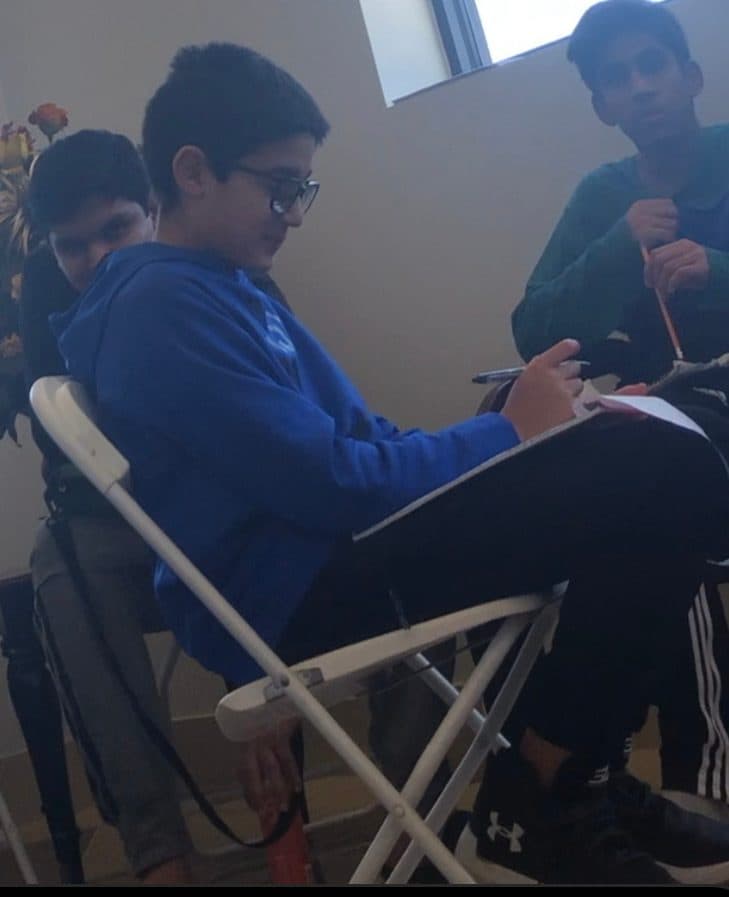
Grammar is learned with a pen in hand. Each week a student works through:
- Morphology and conjugation drills.
- Sentence-building exercises.
- Guided grammatical parsing, or i’rab.
- Short vocabulary assignments drawn from recurring Qur’anic words.
- Reading aloud and translation exercises.
- Application to selected Qur’anic phrases.
- Periodic cumulative reviews.
The course closes with a final annotated passage in which a student demonstrates morphology, syntax, and meaning together.
Primary sequence
Introductory Arabic and English grammar materials, culminating in al-Ajurrumiyyah
Supporting material
Instructor-prepared charts, morphology tables, vocabulary sheets, parsing exercises, and selected passages from the Qur’an and other sacred texts.
By the End
A diligent student should be able to look at a short vowelled Arabic passage and begin explaining how its words are formed, what roles they perform, why their endings change, and how their grammatical relationships carry meaning. He will not have completed the study of Arabic. He will hold a genuine foundation from which direct access to sacred texts becomes possible.
How It’s Taught
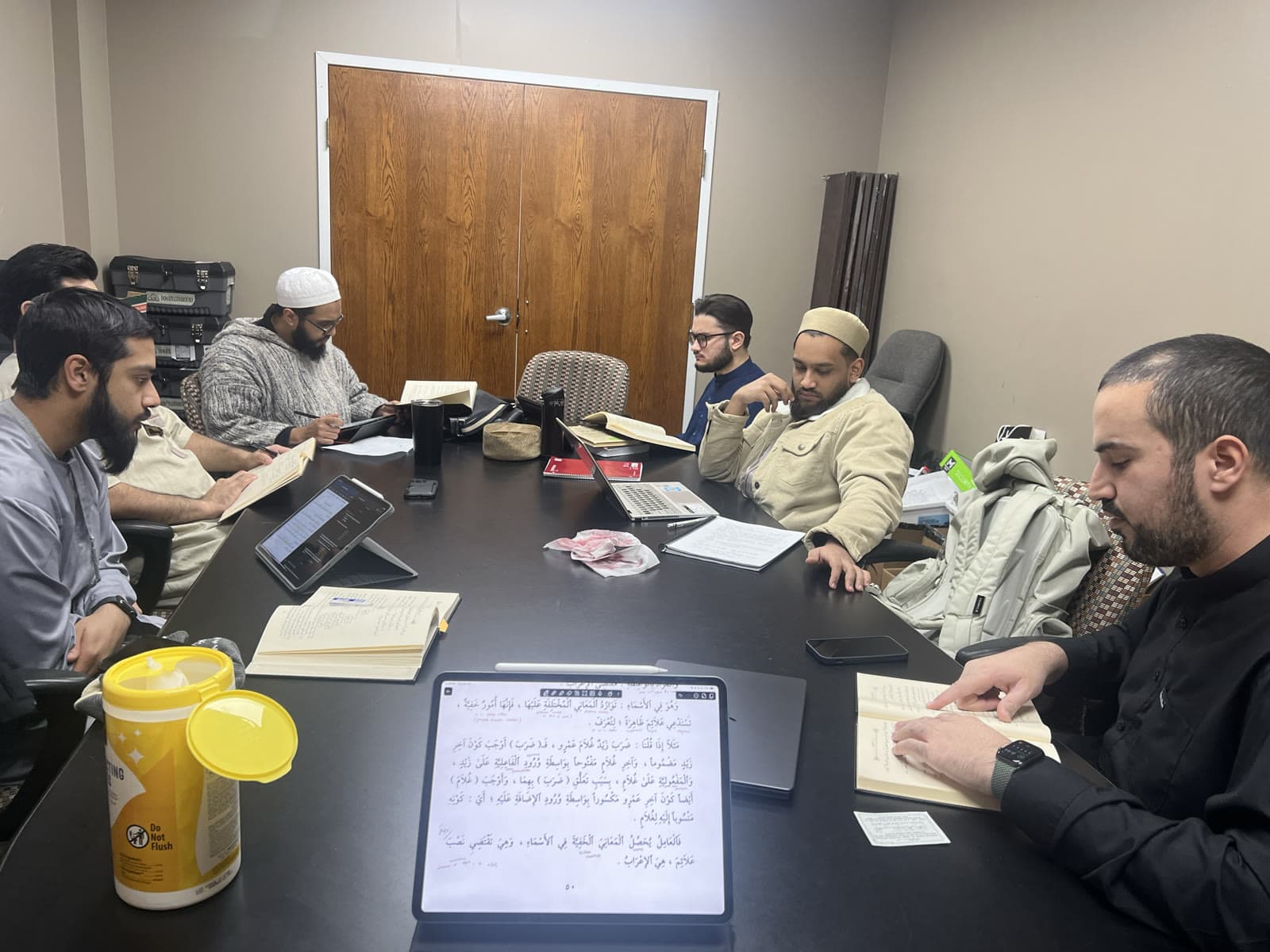
Grammar is a staircase here: each week builds directly on the last, with guided reading exercises from day one, so nothing is memorized without being used.
Online, live cohort. 8 students maximum.

Taught by
Irslan Ahmad
Founder & Lead Instructor
A Hafiz of the Qur’an with an ijazah in the mode of Hafs ‘an ‘Asim, a Master of Arts in Islamic Studies from Bayan Islamic Graduate School, and continuing ‘Alimiyyah study at Darul Qasim College. He teaches this course himself, every week, start to finish.
Read the full biographyThe Details
- Who it’s for
- Young men
- Age
- Young adults, 17–25
- Instructor
- Irslan Ahmad
- Format
- Online, live cohort
- Starts
- To be announced
- Applying
- Applications close two weeks before the first session
- Schedule
- Saturdays & Sundays, 8:00–10:00 AM Central
- Length
- 16 weeks
- Class size
- 8 students maximum
- Outside class
- 2 hours a week of written grammar exercises, pen in hand
- Tuition
- $400
Tuition & Terms
No sincere student is turned away from our student programs for inability to pay. If tuition is the obstacle, write to us before applying, or request a scholarship and we’ll find a way forward.
Refunds: full before the first session, prorated after the first session but before the second, and none once the second session begins; see our Terms of Use.
Ready to join this cohort?
Classes are kept small, so a seat is a commitment on both sides. Apply below and we’ll confirm your place.
Other Courses