

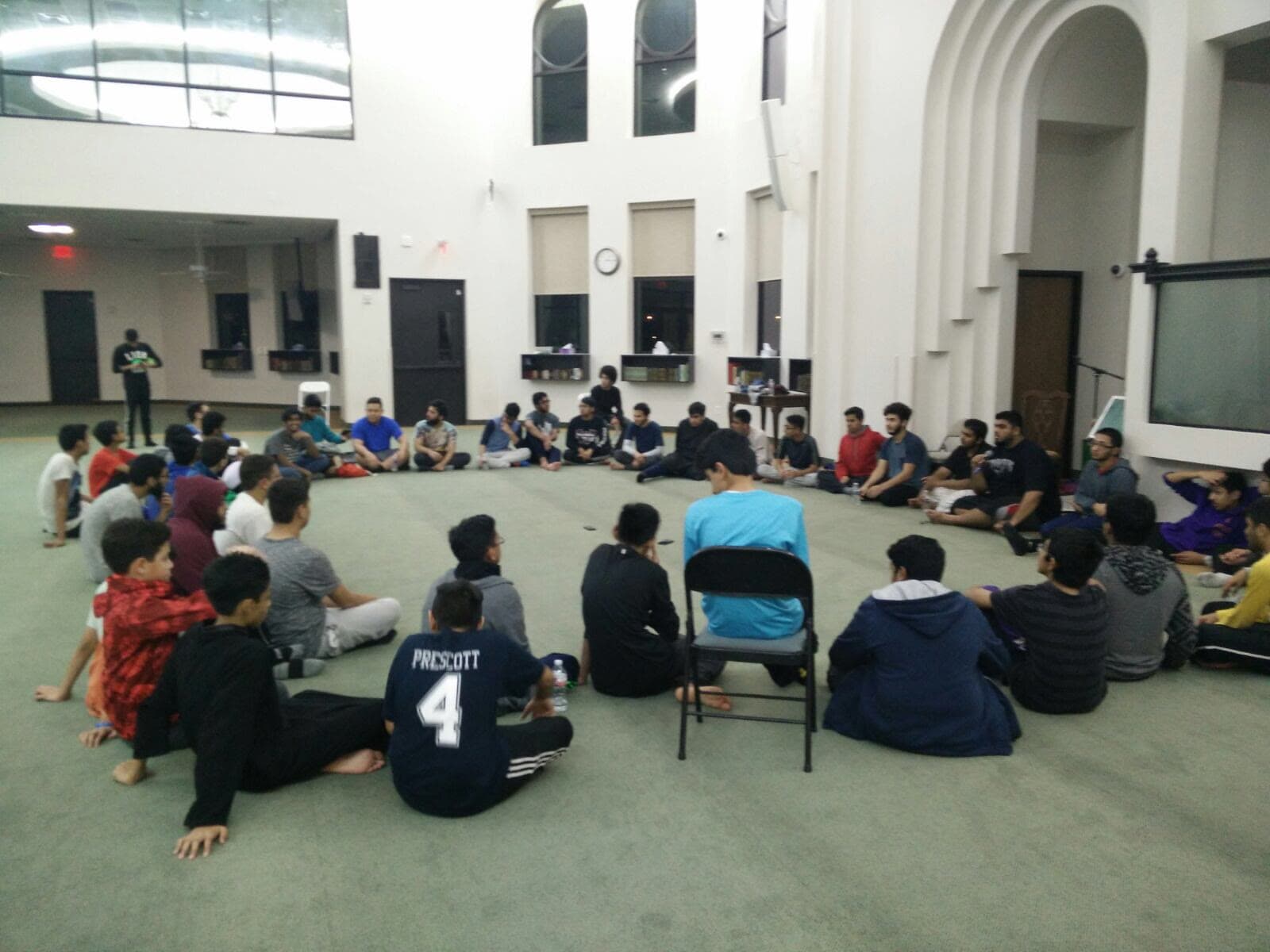
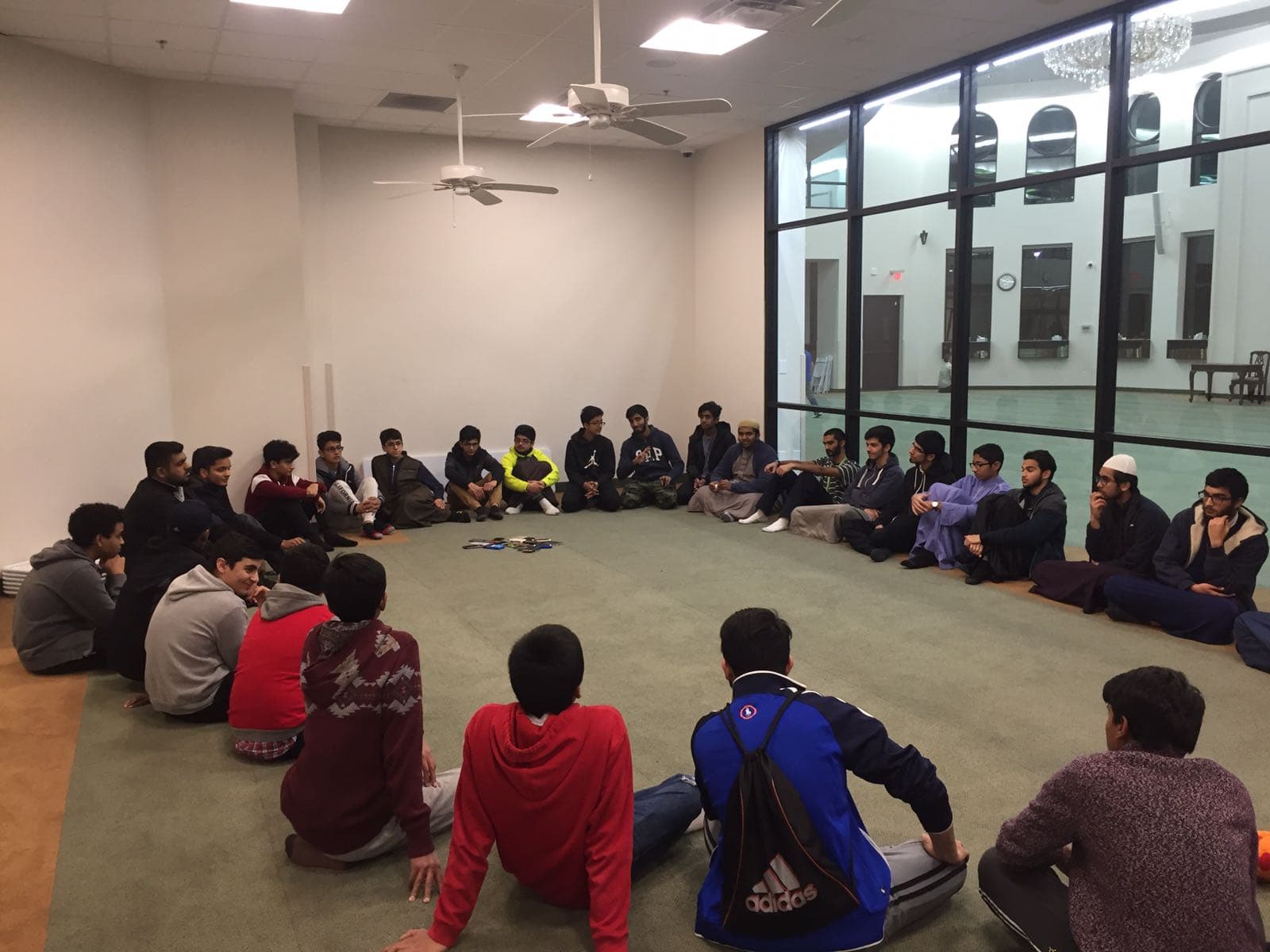
A Weekly Gathering
Scroll to Step Inside a Circle
“They were youths who truly believed in their Lord, and We increased them in guidance.”
Surah Al-Kahf · 18:13
Ihsan Circles bring teens back to the masjid, not with another lecture, but with a mentor who walks beside them. A weekly gathering of 10–15 teens under a trained guide, built on suhbah: sustained companionship, not a one-off event.
Waitlist Open
The next cohort is currently taking applications.
Circles are kept small so every student gets real mentorship. Apply now to be considered for the next opening.
- Who It’s For
- Boys, at this time; we hope to welcome girls once female mentors are in place. Join the list.
- Schedule
- Weekly, one evening (Friday or Saturday), about three hours.
The Problem
Not a character problem. A missing place to belong.
3 of 26
masjid-going young Muslims interviewed said they felt welcomed there
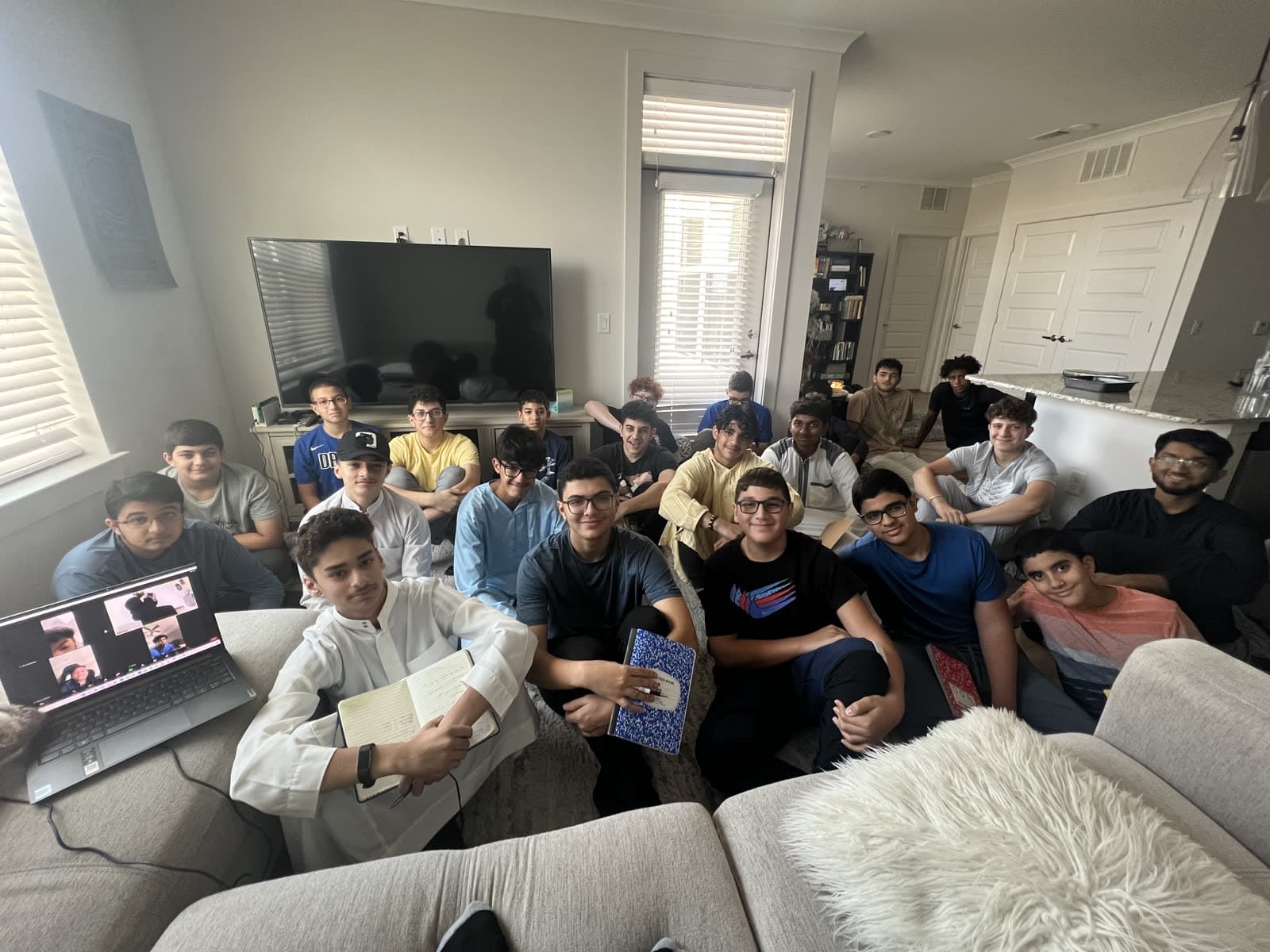
One circle, one mentor, every week: the whole room, on a night nobody was obliged to come
The Parent
Peace of mind, and proof.
Sees real, measurable growth in their child, and finally has a trusted adult helping carry the weight of raising a Muslim teen.
The Teen
A brother, not a burden.
Gains an older brother who understands them and a mentor on the path of sacred knowledge: faith that feels alive, not assigned.
The Mentor
A livelihood, and a calling.
Earns honorably while he studies, sharpens his own knowledge by teaching, and is retained by the community for the long term.
In Their Words
“I believe this program may be the solution to the critical problems of faith and belonging that young Muslims across the country are experiencing.”
Dr. Imam Ahmad Deeb
Said after visiting one Saturday morning, astonished to find thirty-five boys at the masjid at 10 a.m., attending, enjoying, and learning together.
The Method
A brother they trust. A scholar-in-training they follow.
This is not a new idea being tested. The Ihsan Circle model has been running for ten years; its outcomes already written in the lives of the youth who passed through it.
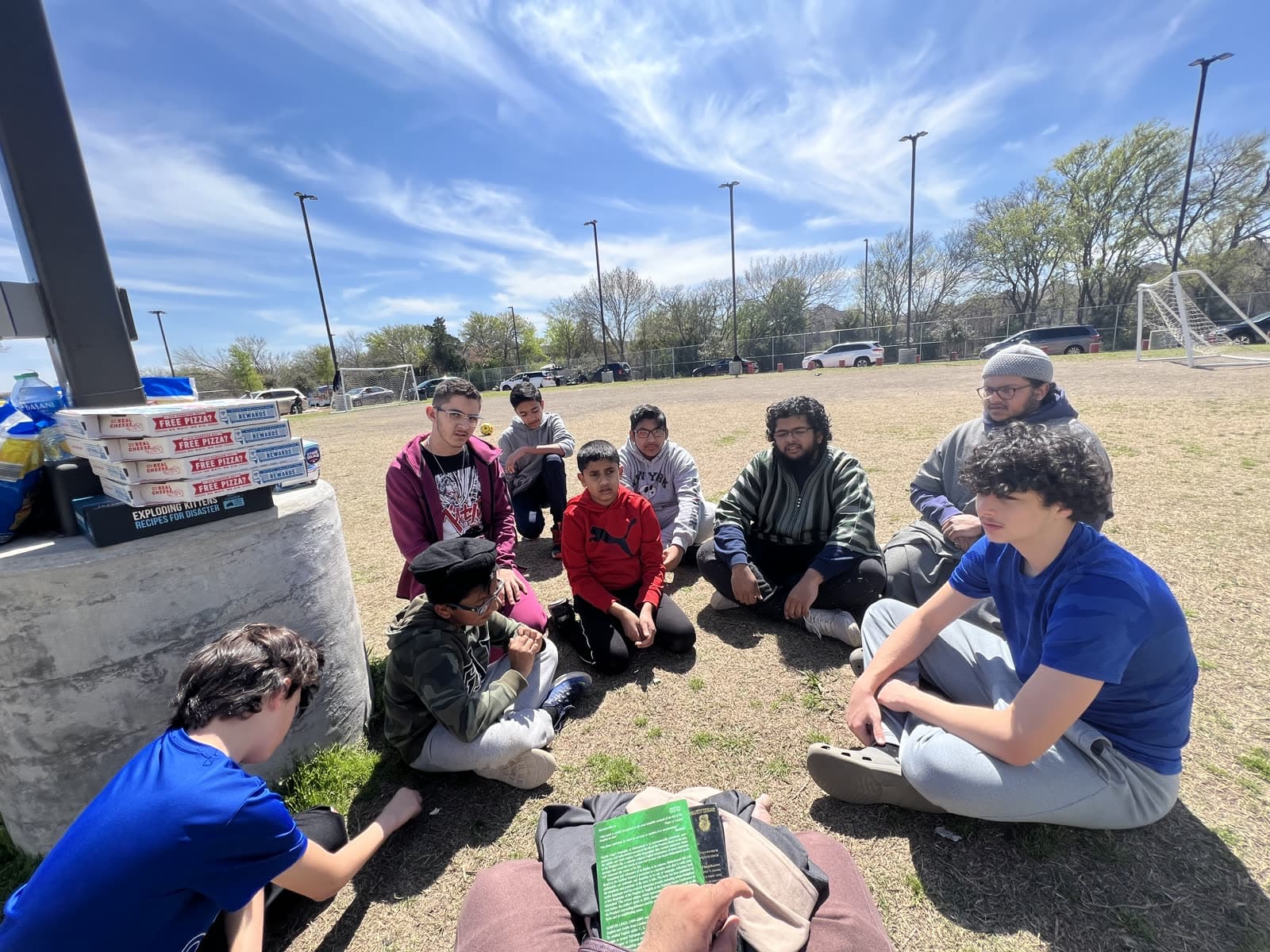
A circle in session: the lesson, wherever they are
The Older Brother
Someone who gets it
He remembers being their age in this country. He knows the group chats, the pressures, the doubts, the double life. Teens don’t perform for him; they confide in him, because he meets them as a peer who has walked the same road, with patience and without judgment.
The Student of Knowledge
Someone worth following
He is not winging it. He is himself on the path of sacred knowledge, a hafiz in seminary training, so when a teen brings a hard question about God, doubt, or how to live, the answer is grounded in the tradition, not improvised.
Moment
Mind
This Week
Immediately Implementable
Every session ends with one concrete action: a du’a to memorize, a service to perform, a conversation to have. Each week, something changes.
In the Room
Experiential, Not Informational
Teens debate, roleplay, journal, and commit out loud. Faith becomes something they practice in the room, not something they’re told to do at home.
Every Day
Unifying the Whole Life
Deen is connected to identity, friendship, ambition, and character: Islam as the framework for everything they already care about.
For Years
Relational & Sustained
One mentor. The same peers. Every week. Sustained relationship, not events, is what durably changes teens.
Heart
Lifetime
Research on experiential learning and sustained relational mentorship: Saafir & Umarji, “How to Raise Religious Teens: A Self-Determination Theory Approach,” Yaqeen Institute for Islamic Research (2022).
A faith they can articulate and own, not one merely inherited
A circle of peers on the same path, so they’re never doing it alone
A mentor for the long haul who tracks their growth and stays in their corner
How It Runs
One evening a week, a rhythm they trust
A single weekly session, Friday or Saturday evening, about three hours, following a consistent arc the teens come to anticipate and rely on.
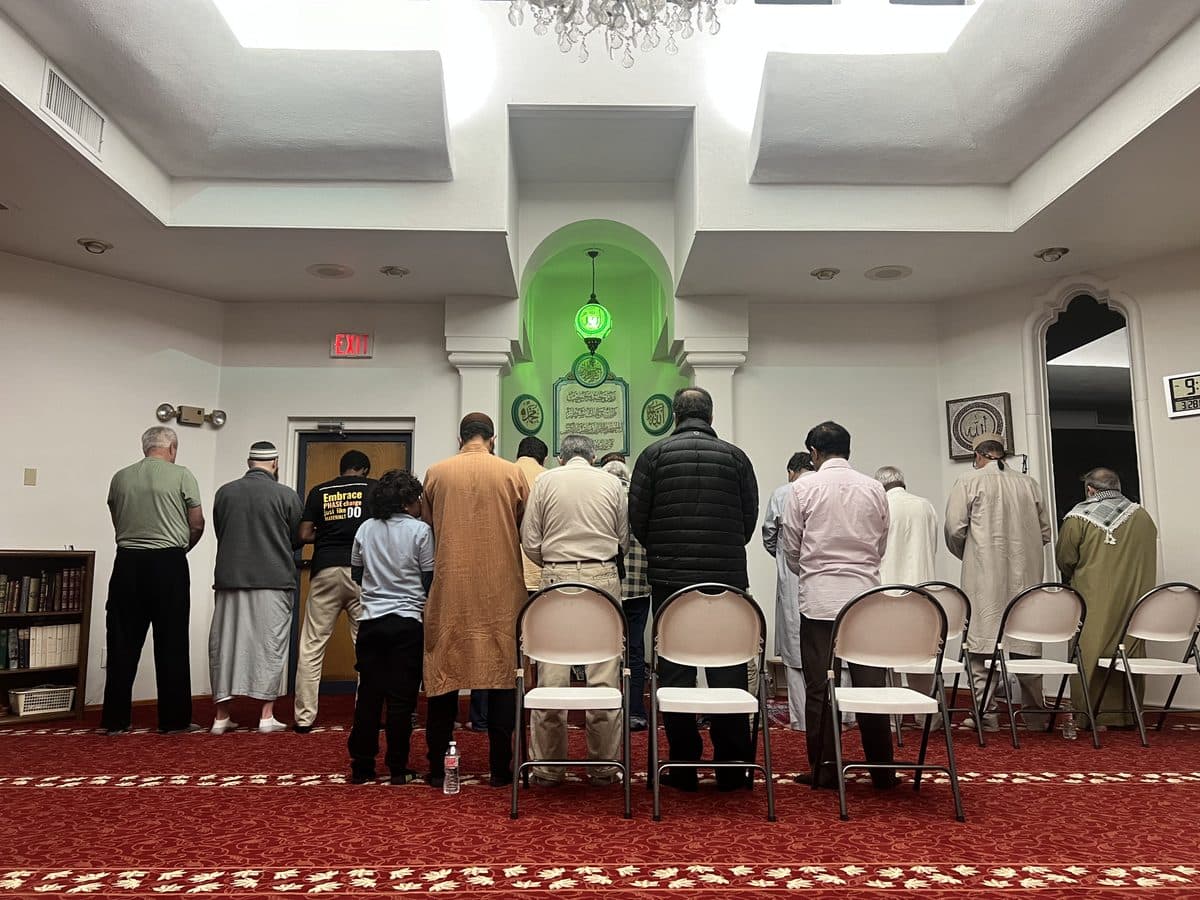
Opening Dhikr & Grounding
A short reflection to settle in and turn attention toward the evening.
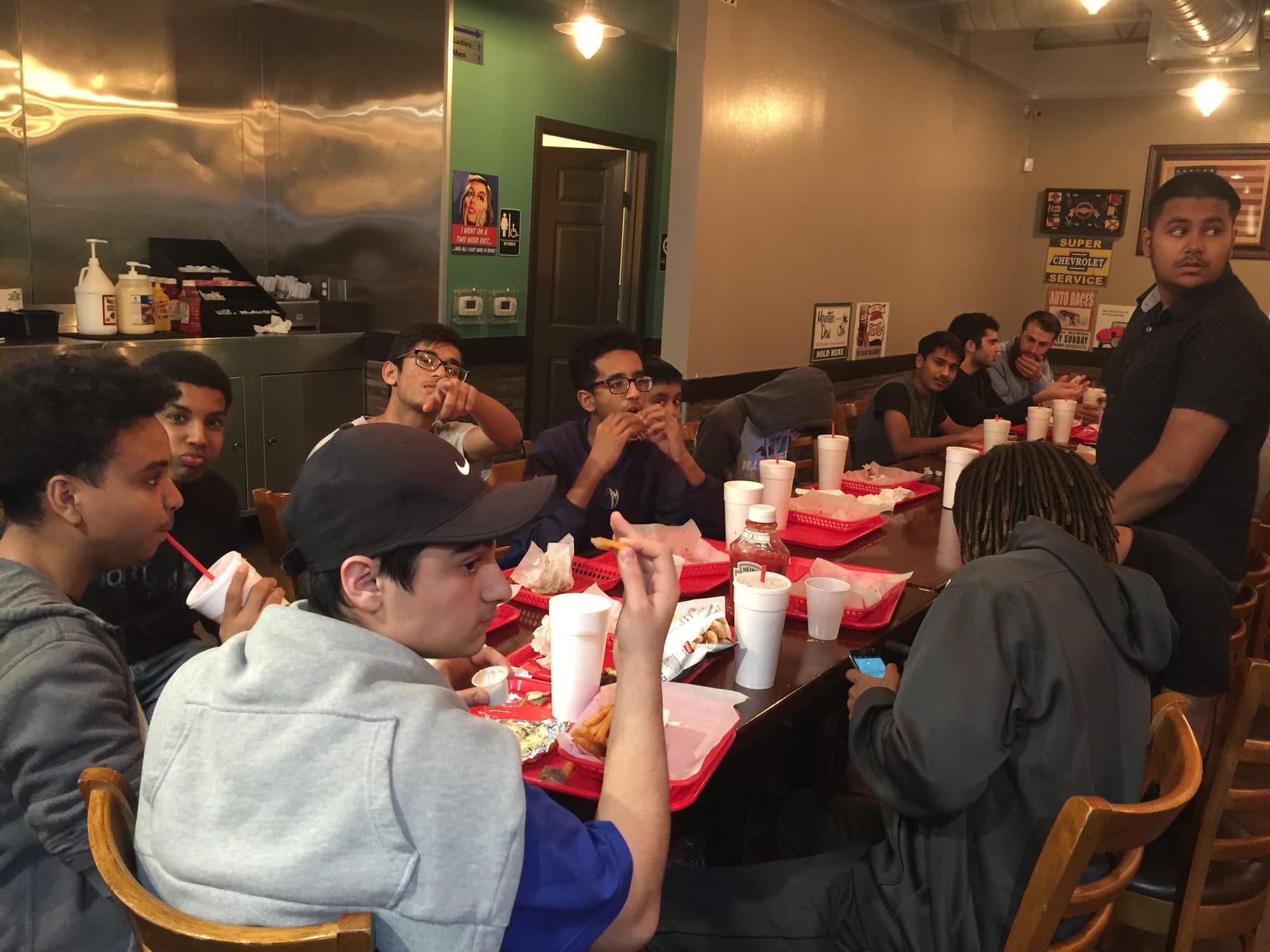
Every session ends the same way: around food, together
The Substance · المنهج
More than one text. One formation.
Cohorts move through multiple classical texts and original curricula: futuwwah, faith, adab, and the purification of the heart, alongside practical training in self-regulation, self-knowledge, and intellectual and spiritual development.
Circles build
- futuwwah.
- faith.
- adab.
- character.
- self-knowledge.
- self-regulation.
- certainty.
- intention.
- vigilance.
- devotion.
- remembrance.
- reflection.
- brotherhood.
- leadership.
- the whole person.
Themes from Recent Cycles
How the Room Runs
Our Standards
The goals every cohort is held to
Twelve-month targets for every cohort, reviewed quarterly. Goals we hold ourselves to, not claims.These are the 12-month targets we set for every cohort: goals we hold ourselves to, not results we’re claiming today. Progress is reviewed quarterly through attendance logs, surveys, and mentor reports.
12-month targets, not results yet
the weekly attendance every cohort is held to
report a stronger faith identity
active in an MSA or organization
lead a service project
parental satisfaction
The Trust Layer · أمانة
Supervision, reporting, money, and your child’s data; the full commitments live on one page. Read our safeguarding standards.
Beyond Face Value
What looks like a class, isn’t
From outside, one more weekly program. Here is what actually changes hands inside it.From the outside, a circle looks like one more weekly program. Set beside the shapes youth work usually takes, here is what actually changes hands inside it.
An Ihsan Circle
A relationship, kept weekly
What it leaves behind
A person, formed
- One mentor, the same peers, every week
- Faith practised in the room: debate, journaling, commitments out loud
- A weekly rhythm sustained for years
- A trained mentor who earns with dignity, and stays
- Measured growth: surveys, milestones, quarterly reports
- Deen connected to the whole life
The Lecture Series
Information, delivered
What it leaves behind
Notes
- A speaker you attend, then leave
- Listening, not practising
- Moving, until the drive home
- Nobody knows who came back
The Youth Event
A high, then home
What it leaves behind
A memory
- Exciting, once
- The high fades by the weekend
- No rhythm to return to
- Nothing measured, nothing owed
The Volunteer Program
Goodwill, on borrowed time
What it leaves behind
A season
- Sincere people, giving what they can
- Volunteers burn out and vanish
- A rotating cast of leaders
- Vague reassurance for parents
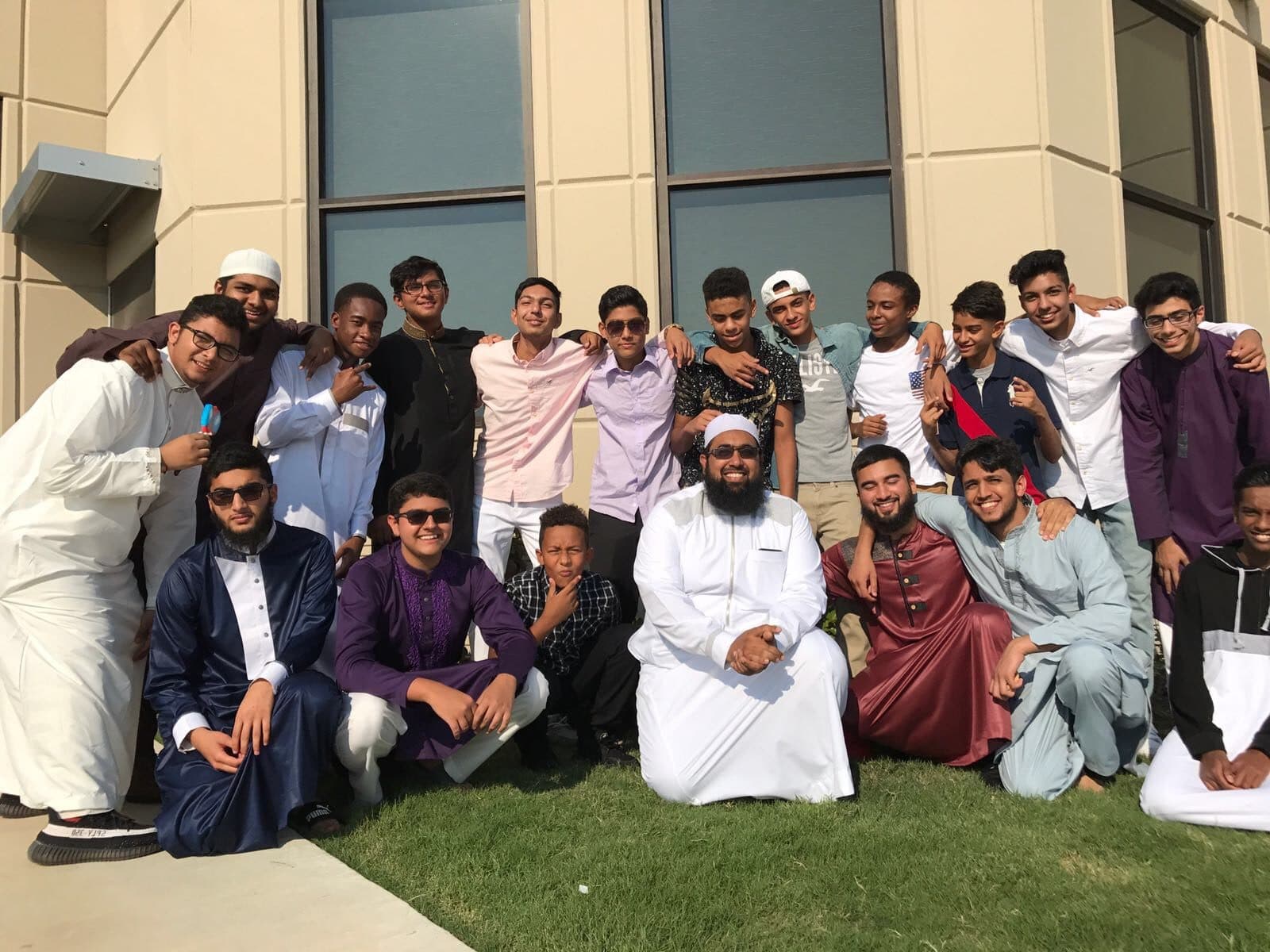
A cohort, with the teacher who stayed
Track Record
What ten years of this model has produced
students taught through six circles across four cities
shahadahs facilitated by students
Muslim groups founded by students and alumni
committed to completing hifz of the Qur’an
now studying the Islamic sciences full-time
students in a single cohort at its peak
The Stories Behind the Numbers
Numbers count students. These are the students.
Story 01
The friends they brought
Every few weeks, one of our teens would bring a friend, someone they had inspired to visit, sometimes even to shahadah. When those boys asked for help learning Islam (how to read Qur’an, how to pray), we opened free morning classes. They came punctually, joined the weekly halaqah, and found a community they belonged to.
Story 02
The boy who wouldn’t take his hood off
He had lost his father, kept his hood up, and never spoke in public. At his mother’s request we enrolled him, then launched an entirely new circle for him, his peers, and his neighbors, asking no compensation. Soon the hood came off and the smile returned: he had found his brothers, and a reason to carry on.
Story 03
The son who was drifting
A mother approached us, in a way that became familiar over the years, describing her divorce and its weight on her son, who was drifting and needed support. We brought him into the circle and along on every outing, never letting his family worry about a cost, and kept him in brotherly company while he found his way.
Story 04
The one who came back to faith
A father asked for our help with a son whose doubts had led him to declare he had left Islam. We met with him again and again: never pushing, helping him reason, giving him time, showing him he mattered, giving him a community, until he returned to faith genuinely, sure of its truth and its value.
The Practicalities · تفاصيل
Details
Eligibility
Teens and young adults, by application; sincerity and commitment matter more than prior knowledge.
Who It’s For
Boys, at this time; we hope to welcome girls once female mentors are in place. Join the list.
Led By
Irslan Ahmad, personally, for every cohort running today. See how the next mentors are trained.
Tuition
$75 per student, per month. Sliding-scale seats are available; no sincere student is turned away for inability to pay.
Location
Western suburbs of Chicago, IL. Online cohorts are possible for a group ready to commit.
Commitment
An initial cycle of about ten weeks, then ongoing suhbah through further texts and curricula for those who continue.
Schedule
Weekly, one evening (Friday or Saturday), about three hours.
Already accepted into a cohort?
Pay TuitionFor Parents · أمانة
Before you hand us your son
A circle asks for a real commitment of trust: a weekly evening, often away from home. These are the terms that trust is held on.
Who is in the room
Mentors are interviewed before involvement and are themselves students of sacred knowledge. Sessions are led by the same mentor each week; you know exactly who is with your son.
No closed doors
No unsupervised one-on-one meetings between a mentor and a minor, held to the same Islamic decorum expected in any setting.
Nothing offsite is a surprise
Any outing or overnight is communicated in advance and requires your written permission. Standard waivers are kept on file.
You can see the curriculum
Every theme and lesson plan is available to you on request, before it is taught, not after.
If your son tells his mentor something serious
A mentor’s job is to be someone a teen actually confides in, which means sometimes what comes up is more than a weekly session can hold alone. A disclosure that suggests real risk (self-harm, abuse, a crisis) goes to Shaykh Haroon the same day, not at the next scheduled report; parents are told, and civil authorities wherever the law requires it. It is never left to one mentor’s individual judgment.
If something concerns you
Raise it directly with Irslan. Concerns are escalated according to our own guidelines, and to civil authorities wherever the law requires it.
How to Join
Bring your teen to a real session, before deciding anything
Tell us about your teen
A short form: their age, interests, and what you’re hoping this gives them.
Come to a free, open session
No commitment. Your teen experiences a real session firsthand before you decide anything.
Enroll, and track real progress
Join the cohort, and receive your first mentor report within the quarter, not vague reassurance.
Questions
What does a circle cost?
Tuition is $75 per student, per month. Sliding-scale spots are available; no sincere student is turned away for inability to pay. You may cancel at any time; cancellation takes effect at the end of the current billing month, per our Terms of Use.
How many students are in a cohort?
10–15 teens per cohort, under one trained mentor, so every student is known. Earlier Dallas cohorts sometimes grew well beyond that; new cohorts are capped on purpose, because the model works through students being known, not counted.
What happens after the first cycle?
The circle continues: cohorts move on to further texts and curricula with the same mentor and the same peers. The relationship doesn’t end when a text does; that’s the point.
How do you track results?
Attendance, surveys, and mentor reports are reviewed quarterly against real 12-month targets; see Outcomes below.
Apply to an Ihsan Circle
Applications are reviewed on a rolling basis. Tell us about the student, and we’ll follow up.
Have questions before applying? Book a call.
Not the right fit? Private Study or Hilaq may suit better.