

Our Philosophy
From Knowing to Becoming
Young Muslims need more than answers to remember: knowledge that enters the heart, and companionship that makes it livable.We believe young Muslims need more than answers to remember. They need knowledge that enters the heart, companionship that makes it livable, and sustained practice through which faith becomes character.
Why This Exists
The best-resourced generation of Muslims is the least accompanied
A Muslim teenager today carries more Islamic knowledge in a pocket than a scholar of a past century could reach in a lifetime of travel: every lecture, every text, every reciter, on demand. If access to content produced character, this would be the most formed generation the ummah has ever raised. Every parent and every imam knows it is not.
The gap was never information. A young person rarely leaves the deen because an argument defeated him; he drifts because nobody with a claim on his heart was standing close enough to notice the drift begin. Files transfer knowledge. Only people transfer conviction.
The Pattern We Follow · الأسوة
Formation was never instruction alone
The Prophet ﷺ did not form the Companions by transmission alone. He explained revelation and embodied it; he stayed close to people; he corrected with wisdom, encouraged, and cultivated hearts over time. His life was the meaning of the message made visible, and his companionship changed the people who kept it.
Ihsan Circle exists to recover something of that wholeness: serious knowledge joined to sincere worship, inward refinement, beautiful conduct, and sustained companionship.
Five Principles
What we hold about learning itself
Every program we run is an application of five convictions, inherited rather than invented.
Knowledge · علم
Knowledge must become beneficial
A lesson is not complete when it has been understood. Learning reaches its purpose when truth passes from the mind into the heart, and from the heart into habit, worship, character, and service. Knowledge that changes nothing in its carrier was never fully received.
The Heart · قلب
The mind and the heart grow together
Character · خلق
Character is built through practice
Companionship · صحبة
People are formed in companionship
The Whole Life · حياة
Ihsan belongs to the whole life
The Chain · السند
Knowledge in this tradition has a chain of custody
Islam is the civilization that made the messenger part of the message. A hadith is graded by the people who carried it; an isnad is not a bibliography but a list of companionships: who sat with whom, for how long, and what it made of them. For fourteen centuries, “where did you read that?” has been the wrong question. The right one is “who did you take it from?”
We did not invent our model. We inherited it. This is our link in that chain, as honestly as we can draw it:
Dallas · the 2010s
A teacher gave a fifteen-year-old a daily ride to school and took his questions seriously.
Dallas · 2017
The student became the teacher. First circles, first cohorts, in the masajid that raised him.
2017–2026
Circles ever since: hundreds of students across two cities, MSA presidents, huffaz, and founders of their own organizations among them.
Today
Students formed in those circles now sit at the head of circles of their own.
Chicago · right now
The next links are being formed. One of them could be your son.
Old School · New Craft
An old school, carried with new craft
Each row is an inherited discipline, given the concrete form a family can see and verify today.
The sanad: knowledge taken from a person, not a platform
Mentors vetted, trained, and supervised, with written reports parents actually receive.
Suhbah: formation through companionship over years
Small cohorts, the same guide every week, an empty seat noticed the same night.
Adab before information: the manners of knowledge
Reflection journals, habit tracking, and commitments spoken aloud and reviewed.
Repetition and memorization as tools of ownership
Spaced review, teach-backs, and Socratic dialogue that makes students build the lesson.
Service as part of study, not a break from it
Service projects on every cohort’s calendar, with the adab of serving taught alongside.
Companionship · صُحبة
Suhbah: who you sit with is what you become
The Qur’an was not published to a crowd. It was revealed to one man, and lived out in front of companions close enough to watch how he ate, judged, forgave, and grieved, and that closeness was the curriculum. The generation it produced was not formed by access to information. It was formed by proximity to a person.
Every branch of our work runs on that same mechanic: one guide, the same students, every week, for years, not a rotating cast of instructors delivering content to whoever shows up. A student who is known, whose week a mentor actually asks about, whose empty seat is noticed the same night, engages differently than a student in an audience. He stops performing attendance and starts belonging. The tradition has a name for such company: living books, people in whose conduct knowledge can be read.
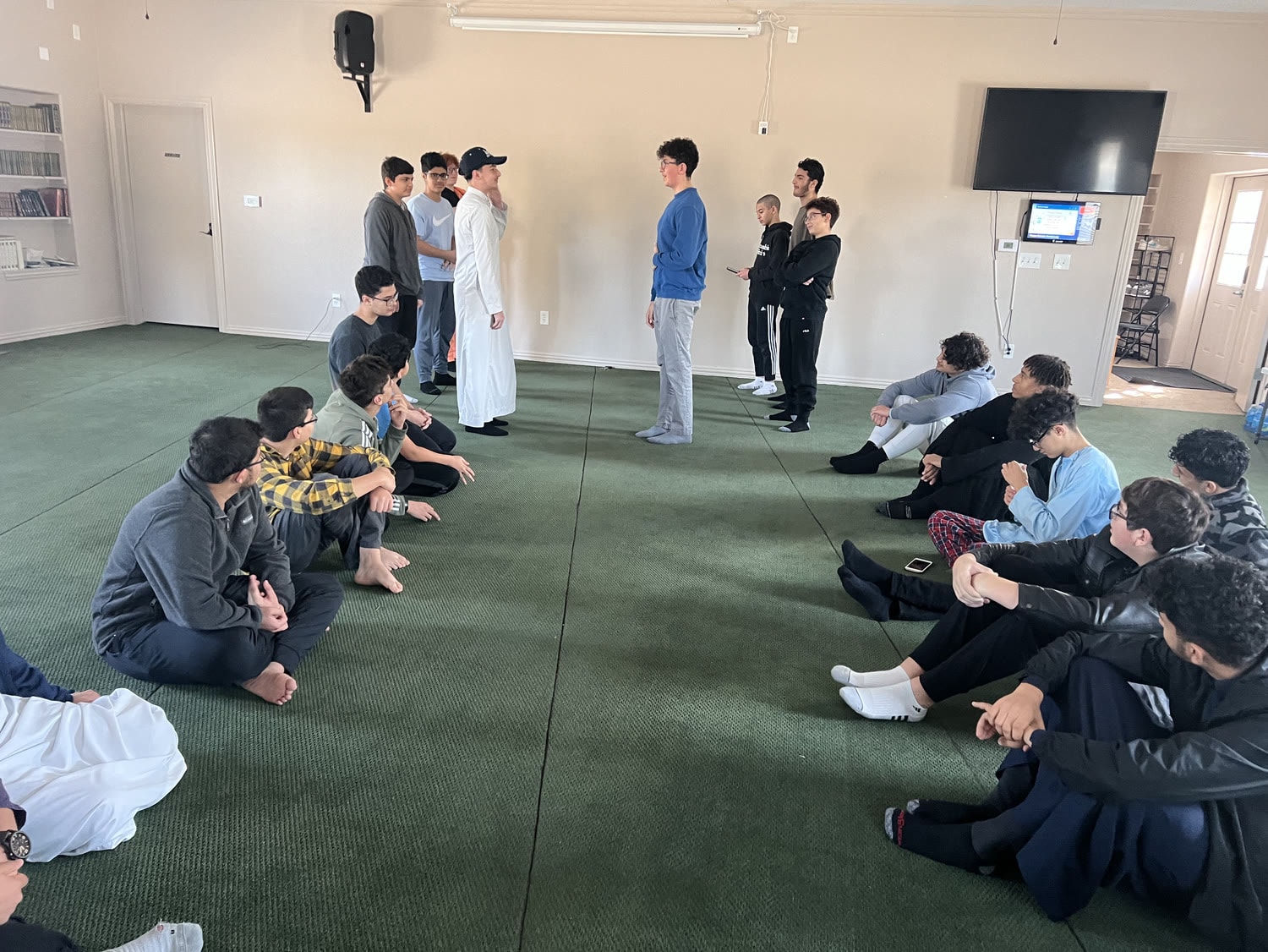
Learning and teaching one another
Excellence · إحسان
Ihsan: a standard, not a slogan
إِنَّ اللَّهَ كَتَبَ الْإِحْسَانَ عَلَى كُلِّ شَيْءٍ
Verily, Allah has prescribed excellence in everything.
When Jibril asked the Prophet ﷺ what ihsan is, the answer was not a technique but a posture: to worship Allah as though you see Him. Excellence in this tradition is not what you produce when the room is full. It is what you cannot help producing because the Audience is constant.
In practice, that standard is unglamorous: a curriculum followed rather than sat through once, attendance that is reviewed, mentor reports written on a schedule. Ihsan shows up in the parts of the work no one is watching: the lesson plan prepared for one session with fifteen students, given the same care as a keynote.
And ihsan does not stay inside worship. It is faith internalized: the awareness that Allah sees us becoming the hidden center from which choices, speech, friendship, study, and service proceed. We care about excellence, but not performance for its own sake. The deepest work is often quiet: a corrected intention, a promise kept, a teacher returning week after week for the sake of Allah.
Guided growth, not self-study
Structured Mentorship: a ladder, not a lobby
Most youth programming has exactly two roles: the one talking and the ones sitting. Nobody drifts out of a room faster than a seventeen-year-old who has figured out he is an audience. We run four roles, and every one of them is a rung:
- 01
General
Shows up weekly, is known by name, and is missed out loud when absent.
- 02
Committee
Given responsibility that matters, and is checked.
- 03
Core
Prepares and teaches under a mentor’s supervision, with feedback after every session.
- 04
Alumni · Mentor
Leads a circle of his own. The formed becomes the one forming.
The structure exists to produce a handoff: the student who was formed becomes the one forming. That is the only success metric that compounds. At every rung, the mentor’s work is the same: helping a student cross the distance between knowing what is right and becoming able to live it.
Held Deliberately
What we refuse, and what we choose instead
A philosophy is only as honest as what it costs. These are trades we make on purpose, and keep making.
01We refuse
Entertainment-first youth work, where the pizza is the point.
We choose
Real texts and real questions, and pizza after, not instead.
02We refuse
Scale as proof: five hundred strangers in a ballroom, counted as impact.
We choose
Twelve students a guide can actually know, hold, and answer for.
03We refuse
One more lecture into the feed of a generation already buried in them.
We choose
The same faces at the same table, week after week, for years.
04We refuse
Attendance as the finish line.
We choose
Attendance as the floor, formation as the goal: who returns, who leads, who teaches next.
The Wager
We do not expect transformation to happen in a single lesson. We build small, sustained environments in which a student can know the truth, love it, practice it, struggle with it, return to it, and eventually carry it for others.
We are patient on purpose. A circle takes years to show what it made, and we think a generation is worth that kind of time.
See the philosophy in practice
Read the story of how it started, or look at any of the five programs built on it.
Or explore the full About page.